From Atheism to Faith: How a Personal Encounter with the Holy Spirit Transformed My Understanding of Scripture and Life
1. When the Bible Finally Began to Make Sense
This Holy Spirit testimony is a personal account of how my journey from atheism to Christian faith changed my understanding of Scripture and the way I live.
Before encountering God and the Holy Spirit, I struggled to understand the New Testament. Even when Christian friends explained its teachings, much of what they said remained a mystery to me.
The Holy Spirit was particularly difficult to comprehend.
What was the Holy Spirit? What did Christians mean by a divine presence dwelling within them?
As an atheist, I had no frame of reference for such an experience.
Everything changed after my encounter with God.
I described that extraordinary encounter in my earlier testimony, “How I Encountered God in a Moment of Despair and Crisis.”
I began to understand the Christian belief that the Scriptures were written under the inspiration of the Holy Spirit. Passages that had once seemed obscure gradually became meaningful.
I felt as though my spiritual eyes had been opened. Sometimes, after struggling with a difficult passage, its meaning would suddenly become clear.
The Apostle Paul wrote:
“But the natural man receiveth not the things of the Spirit of God: for they are foolishness unto him: neither can he know them, because they are spiritually discerned.”
In time, I came to see my own experience reflected in these words.
2. A Vision of Jesus on the Cross at Golgotha
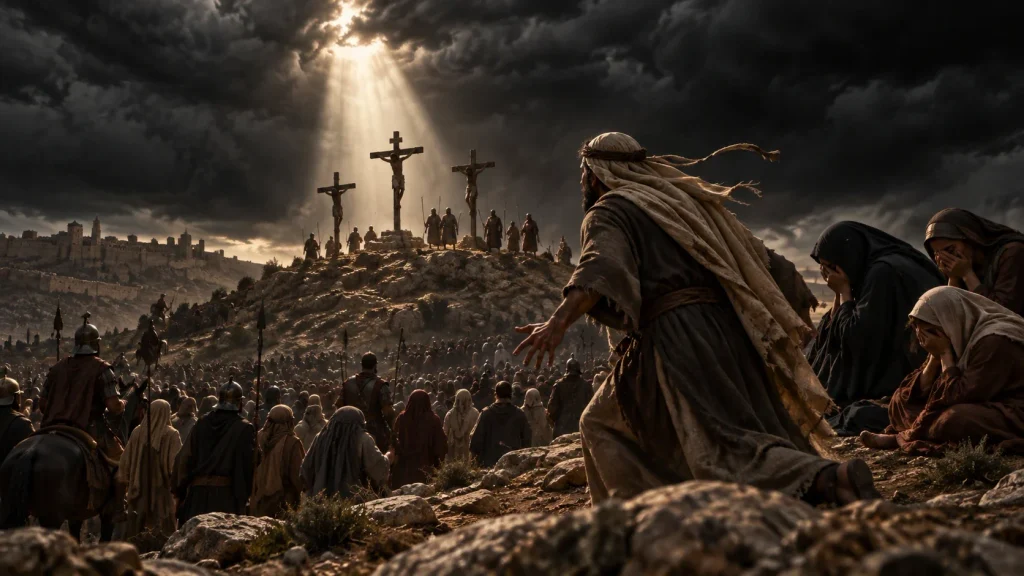
One day, while reading the Gospels alone in my room, I came to the account of Jesus’ crucifixion.
I found myself wondering:
“How did Jesus endure His final moments? How terrible must His suffering have been?”
As I contemplated these questions, something extraordinary happened.
The room around me seemed to dissolve, and a completely different scene appeared before my eyes.
I saw a hill surrounded by an enormous crowd.
Although it was daytime, the surroundings were strangely dark. Heavy black clouds covered the sky, and a narrow shaft of light illuminated the hill.
Three men hung upon crosses at the summit.
Jesus was on the cross in the center.
I believed I was seeing Golgotha, the place of crucifixion described in the Bible.
The crowd stood watching.
To my right was a man overwhelmed with anguish. He appeared ready to rush toward the hill, unable to contain his grief. He wore clothing reminiscent of ancient Judea, and the cord securing his head covering had come loose, fluttering in the wind.
Behind him, three women sat on the ground, covering their faces and weeping.
I looked toward Jesus.
My viewpoint was not directly in front of Him but approximately 60 to 70 degrees behind Him. From that position, I could see only part of His profile.
The scene was extraordinarily vivid.
I understood this experience as a spiritual vision through which the Holy Spirit was helping me comprehend the Scriptures.
It was not the only time I experienced what I believed to be His guidance. As I continued reading the New Testament, passages that had once confused me sometimes became clear in unexpected ways.
Gradually, I found myself able to study and understand Scripture on my own.
3. A Buddhist Friend and an Unexpected Biblical Passage
Not long after these experiences began, I met a friend from high school who practiced Buddhism.
Knowing that I had become a Christian, he said:
“I suppose you won’t want to see me anymore, since I’m a Buddhist.”
I replied without hesitation:
“That is for God to decide, not for me to judge. I’ll continue to see you just as I always have.”
That evening, I opened my Bible and happened upon a passage in Paul’s First Letter to the Corinthians:
“Yet not altogether with the fornicators of this world, or with the covetous, or extortioners, or with idolaters; for then must ye needs go out of the world.”
— 1 Corinthians 5:10 (KJV)
I paused to reflect on those words.
Paul was explaining that Christians were not expected to cut themselves off from everyone outside their faith. To avoid all contact with people who did not live according to Christian teachings would mean withdrawing from the world itself.
The passage seemed remarkably consistent with what I had told my friend only hours earlier.
Several similar experiences followed. I would occasionally express a thought spontaneously, then discover a passage of Scripture days later that seemed to convey the same principle.
Each time, I was struck by the unexpected connection.
These experiences gradually led me to a personal conviction: the Holy Spirit can awaken an understanding of God’s teachings in a person’s heart even before that person has studied the Bible.
4. Learning to Live According to God’s Commandments
During this period, I also experienced what I understood to be spiritual guidance concerning how I should live.
I believed that the Holy Spirit, at times through messengers or angels, was drawing my attention to areas of my character and conduct that needed improvement.
The lessons centered on three principles:
Honor your father and mother.
Love your neighbor as yourself.
Do not covet what belongs to others.
The command to love one’s neighbor is not listed separately among the Ten Commandments, but Jesus identified it as one of the two greatest commandments.
These teachings brought a new dimension to my understanding of morality.
Even as an atheist, I had tried to live according to my conscience and observe many basic moral principles. Now, however, I began to see them not merely as social obligations but as responsibilities before God.
I had already declared my faith when I first encountered Him.
I remembered being asked:
“Do you still find it difficult to believe in Me?”
My answer had been unequivocal:
“I believe in You, Lord, as surely as I see the sun by day and the moon by night.”
Because of that experience, I felt that my belief in God Himself no longer required further reassurance. What remained was learning how to live in accordance with His will.
In John 14:26, Jesus spoke of the Holy Spirit as the One who would teach His followers and remind them of His words:
“But the Comforter, which is the Holy Ghost, whom the Father will send in my name, he shall teach you all things, and bring all things to your remembrance, whatsoever I have said unto you.”
— John 14:26 (KJV)
Looking back, I found particular meaning in this promise.
I came to believe that Scripture was inspired by the Holy Spirit, while also recognizing that God’s work extends beyond what any written account can fully describe.
Before my encounter with God, the Holy Spirit had been an incomprehensible religious concept to me. Now I believed I had experienced His guidance in understanding Scripture, examining my own conduct, and growing in faith.
The greatest change was not simply that I could understand the Bible. It was that I had begun to see my life—and my responsibility toward others—in an entirely different light.
What had begun as an extraordinary spiritual encounter was becoming a lifelong journey of faith.